Mars
Seven minutes, and no one at the controls.
By NASA’s count in 2021, about half of all attempts to land on Mars had failed. Until 2021, only one nation had ever landed on Mars and heard back for more than twenty seconds.
The reason is the air.
02 · No second try
EVERY 26 MONTHS · 203 DAYS
There is
no second try.
Earth laps Mars about once every 26 months, and that is when a craft leaves: a few weeks when the two planets sit where a fall around the Sun from one lands on the other. Outside those weeks the same trip costs far more fuel than anyone can afford to lift, so in practice nobody tries. Perseverance left Cape Canaveral on 30 July 2020 and flew for 203 days and 472 million kilometres. Everything that would happen in the last seven minutes was on board before it arrived. Miss the window, or the landing, and the next chance is two years away.
03 · Jezero
JEZERO CRATER · 45 KM ACROSS
Aimed at a crater
that used to be a lake.
Jezero is a crater 45 kilometres wide. About 3.5 billion years ago a river ran into it and it was full of water; the delta that river left behind is still there, in the rock. Water, rock and time are where life leaves traces, if there was any. That is why it was chosen. It is also why the landing was hard: a delta comes with cliffs, dunes and boulder fields, and the rover would have to see where it was going.
04 · The air
THE ATMOSPHERE
Thick enough to burn you.
Too thin to catch you.
Mars has an atmosphere: about 95 % carbon dioxide and, at the surface, less than 1 % as dense as Earth’s. Arrive at 19 500 km/h and that thin air is still a wall: the shock in front of the heat shield reaches about 1 300 °C. But the same air cannot finish the job. On Earth a parachute brings a capsule down to walking pace; on Mars a canopy 21.5 metres across, the largest yet flown there, still leaves the craft falling at about 300 km/h.
05 · Nobody is flying it
18 FEBRUARY 2021 · PERSEVERANCE
Nobody
is flying it.
On this day a radio signal takes 11 minutes and 22 seconds to travel from Mars to Earth. The landing takes about seven. Every word that reaches mission control describes something that has already happened. The spacecraft is alone with its own computer.
A radio signal needs 11:22 to cross from Mars to Earth. WHAT EARTH KNOWS lags WHAT IS HAPPENING by that much: Entering the atmosphere at E+ 0:00, heard on Earth at E+ 11:22; Parachute open at E+ 4:00, heard on Earth at E+ 15:22; On the ground at E+ 7:00, heard on Earth at E+ 18:22.
06 · Entry
E+ 0:00 · ABOUT 130 KM UP
The first four minutes
are fire.
The heat shield meets the atmosphere at roughly 19 500 km/h. Seventy-five seconds later its surface is near 1 300 °C. By the time the air has done its work the craft is under 1 600 km/h, still faster than sound, still 11 km up.
- TIME FROM ENTRY: E+ 0:00 to E+ 4:00
- SPEED: 19 500 to 1 500 KM/H
- ALTITUDE: 130 to 11 KM
In order: ENTRY · PEAK HEATING · 1 300 °C · PEAK DECELERATION · PARACHUTE.
07 · The parachute
E+ 4:00 · 11 KM · 1 500 KM/H
A parachute opens
at Mach 1.7.
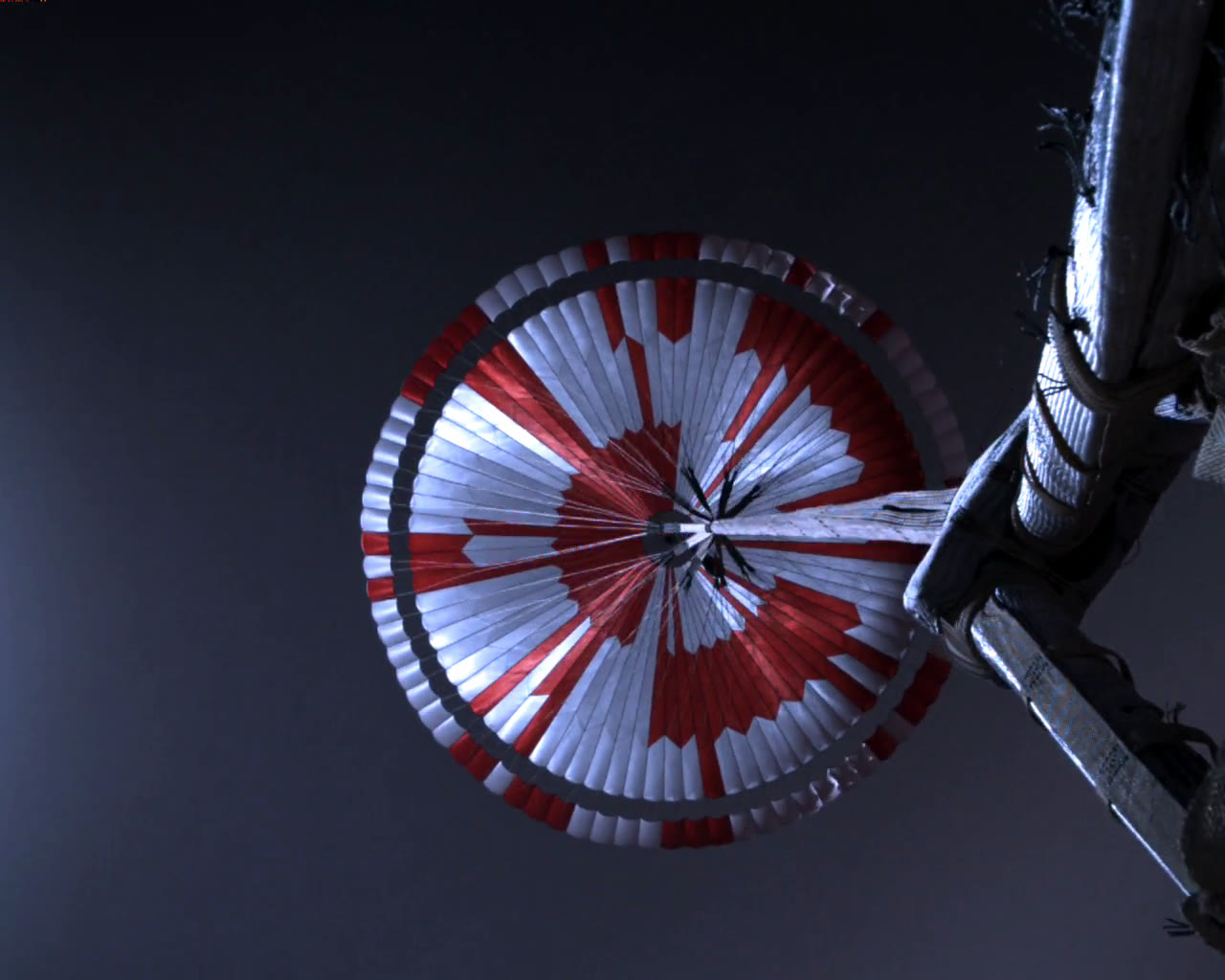
It inflates in about half a second into a wind faster than sound. The moment it opens is not fixed in advance. The computer picks it from where the craft actually is, not from how fast it is going, so that the target ellipse shrinks to a tenth of Curiosity’s. Twenty seconds later the heat shield falls away and the radar sees the ground.
08 · Dare mighty things
THE PARACHUTE · 80 GORES · THREE RINGS
The pattern
is a sentence.
The red and white panels are not decoration. Engineers wove a message into the canopy in binary: each ring one word, ten gores a letter, white for 0, red for 1, the number being the letter’s place in the alphabet. The outer ring, not drawn here, gives the coordinates of the laboratory in Pasadena where the rover was built. NASA said only that there might be something to find. By reporters’ accounts it was read within hours.
Read clockwise, white 0, red 1, ten gores a letter: the pattern spells DARE MIGHTY THINGS.
09 · The machine decides
4.2 KM → 2.2 KM · TERRAIN-RELATIVE NAVIGATION
It looks down
and recognises the ground.
Between 4.2 and 2.2 km a camera photographs the surface and the computer matches the pictures against a map made from orbit. In under ten seconds it knows where it is to about 40 metres. Then it picks the safest spot it can still reach and steers for it. Earth will not hear about any of this for eleven minutes.
- 01 · Photograph: Three pictures in the first five seconds, then one every second.
- 02 · Match: Each picture is compared with an orbital map of Jezero crater.
- 03 · Fix: Position known in under ten seconds. (± 40 M)
- 04 · Divert: Fly to the safest reachable spot. (UP TO 600 M)
10 · The target
1976 → 2021 · THE LANDING ELLIPSE
The target
shrank roughly four hundred times.
Nobody aims at a point on Mars. They aim at an ellipse: the patch where the craft will come down, given everything that can push it about. Viking’s was the size of a small country. Perseverance’s, drawn on the same map at the same scale, is the dot in the middle. By published dimensions, the landing area became roughly four hundred times smaller.
- 1976 · Viking: 220.0 × 100.0 KM
- 1997 · Pathfinder: 200.0 × 100.0 KM
- 2004 · Spirit: 78.0 × 10.4 KM
- 2012 · Curiosity: 25.0 × 20.0 KM
- 2021 · Perseverance: 7.7 × 6.6 KM
By published dimensions, Perseverance’s landing area is roughly 400 times smaller than Viking’s.
11 · The sky crane
E+ 6:40 · 20 METRES
Twenty metres up,
it lowers itself on ropes.
The engines slow the descent stage to a crawl about 20 m up. The rover, one tonne, is let down on three nylon cords 7.6 m long and touches the ground at 2.7 km/h. Blades cut the cords; the stage throttles up and flies off to crash well clear.
Backshell separation at 2 100 m and 306 km/h; the descent stage slows to a hover at 20 m, 2.7 km/h, lowers the rover on its cords, cuts them and flies away.
12 · Seconds before touchdown
18 FEBRUARY 2021 · A FEW METRES UP
The stage looked down
and took this.
A camera on the underside of the descent stage filmed the rover swinging a few metres above Jezero. Then the blades cut the cords, and the stage flew off to crash well clear. Curiosity had filmed the ground coming up in 2012, from one camera. This time six cameras rode down and five sent back pictures: the parachute opening, the heat shield falling away, the rover on its cords. NASA called it footage of its kind for the first time.
WEIGH SOMETHING ON MARS
The rover on those cords is one tonne. Under Mars’s pull, 38 % of Earth’s, it hangs like 390 kilograms would here. Type a weight on Earth and watch.
13 · The graveyard
WHAT FAILED · SIX LANDERS, TWO ORBITERS
The ones that
did not get this far.
- 1971 · Mars 2: Entered the atmosphere too steeply. NASA’s history says its parachute never deployed; the exact sequence is not known. It hit the surface anyway, the first human-made object to reach Mars.
- 1971 · Mars 3: Landed. Went silent within about 20 seconds. The cause was never established.
- 1974 · Mars 6: Contact lost moments before the expected landing; whether it reached the ground intact is not known.
- 1993 · Mars Observer: Lost three days before it was to enter orbit. Most probable cause: a propellant line ruptured while the tanks were being pressurised.
- 1999 · Climate Orbiter: One ground file gave thruster forces in pound-seconds instead of newton-seconds. It flew into the atmosphere at 57 km, not 150.
- 1999 · Polar Lander: NASA’s most probable explanation: when its legs unfolded, the jolt set a “touchdown” flag; at about 40 m the software read the flag and shut the engines. It would have hit the ground at about 22 m/s.
- 2003 · Beagle 2: Landed. Found from orbit in 2015 only partly unfolded: with not all of its solar panels open, its antenna could not transmit.
- 2016 · Schiaparelli: A motion sensor saturated for about a second. The computer decided it was already below the surface, released its parachute at 3.7 km and fired its engines for 3 seconds instead of 30.
14 · Eleven minutes late
18 FEBRUARY 2021 · 20:55 UTC · EARTH
The signal arrived
eleven minutes late.
At 20:55 UTC the word came into mission control: touchdown confirmed. By then Perseverance had been standing on Mars for eleven minutes and twenty-two seconds, on its wheels, alone, waiting for someone to find out.
SEND A MESSAGE TO MARS
Nobody could help, and nobody could even know. Write something and send it: the clock is mission time, compressed; the distance is not.
15 · The first sound
20 FEBRUARY 2021 · JEZERO CRATER
Two days later,
it listened.
Bolted to the rover’s body was a microphone, an ordinary, off-the-shelf part, added so the engineers could hear their own landing. It missed the descent: no usable sound came down with the craft. Then, on 20 February, on the ground, it picked up a few seconds of Martian breeze. NASA played it to the world two days later, the first microphone recording from Mars to be released.
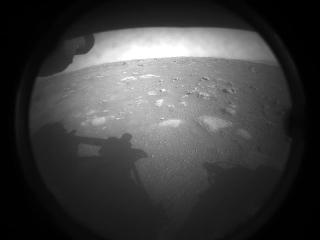
Recording: PLAY THE WIND (0:18). NASA / JPL-Caltech · EDL microphone, 20 February 2021 · rover noise filtered out
16 · The helicopter
19 APRIL 2021 → 18 JANUARY 2024
It carried a helicopter
built for five flights.
Strapped under the rover was Ingenuity: 1.8 kilograms, a technology test given thirty days and five flights to prove that anything at all could fly in air that thin. It flew 72 times over nearly three years, 17 kilometres in all, two hours and nine minutes aloft. On 18 January 2024 it came down hard and broke a rotor blade. A week later NASA ended the mission.
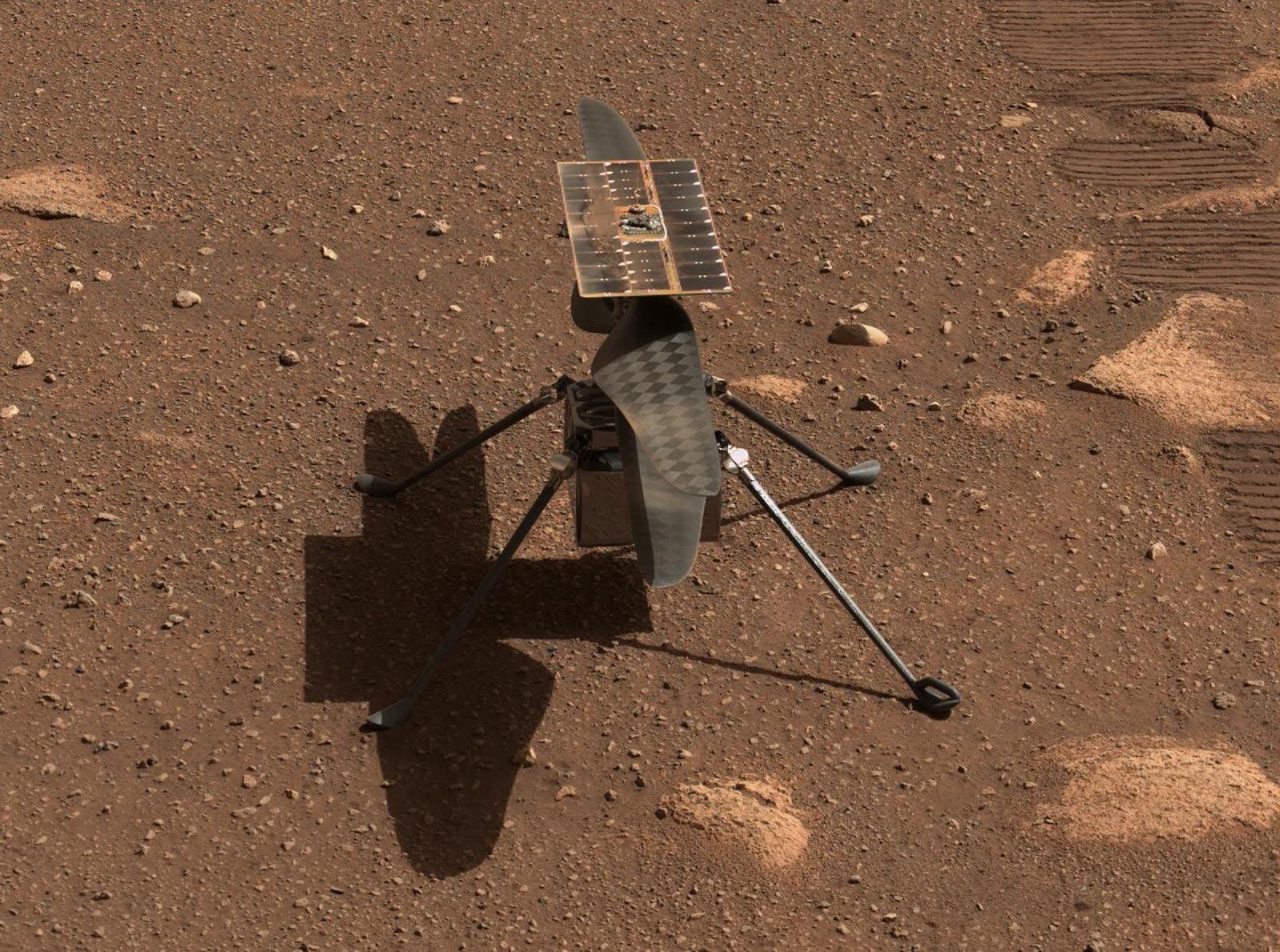
- PLAN · Five flights: A thirty-day demonstration. Anything after that was a gift. (5)
- FLOWN · Seventy-two: The first flight lasted 39.1 seconds. The last, on 18 January 2024, ended with a broken blade. (72)
- GROUND · Distance: Across the crater floor and up the delta, scouting for the rover. (17.0 KM)
- AIR · Time aloft: In total, over three years. (128.8 MIN)
17 · Still there
THREE FORKS · JEZERO CRATER
Ten tubes lie on the sand,
waiting for a ride.
Perseverance carries 43 tubes: 38 for rock and dust, five to record what the rover itself might have brought along. Between 21 December 2022 and 28 January 2023 it laid ten sealed tubes on the ground at a place called Three Forks, a backup in case the rover could not hand them over itself. The mission to fetch them was due to be confirmed in 2026. In January 2026 Congress declined to fund it, and NASA closed the programme office. No successor has been announced.
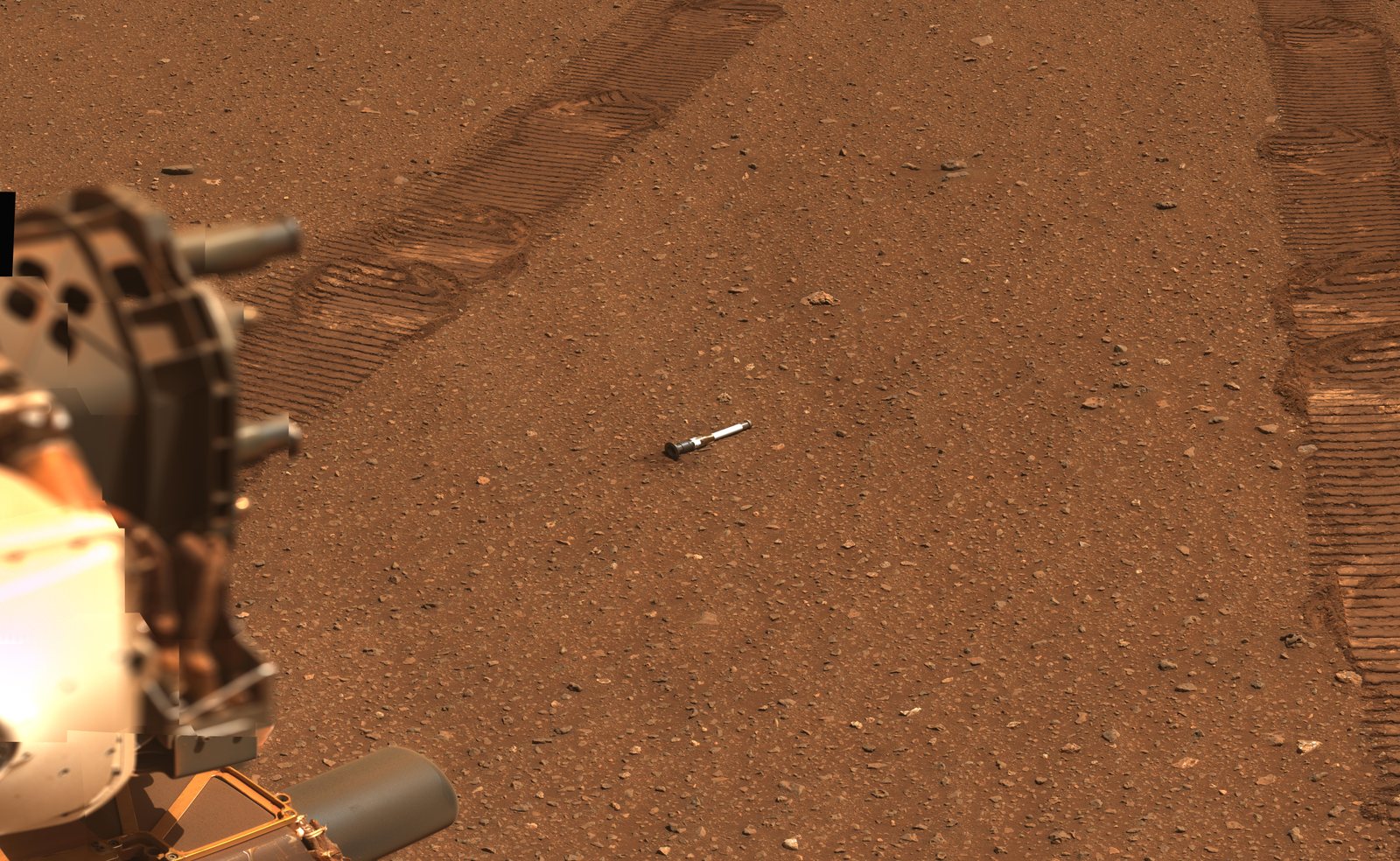
The tubes are still there. Mars is good at keeping things. By NASA’s count in 2021, about half of all attempts to land there had failed.
Sources & notes
- NASA, “NASA’s next Mars rover is ready for the most precise landing yet” (16 Feb 2021): “only about 50% of all previous Mars landing attempts have succeeded” primary
- NASA/JPL, Mars 2020 Perseverance landing press kit (Feb 2021): entry speed, 1 300 °C, parachute 21.5 m at ~11 km, Range Trigger, TRN figures, backshell separation 2.1 km / 306 km/h, sky crane 20 m / 7.6 m cords / 2.7 km/h, 11 min 22 s light time, rover mass primary
- NASA, Perseverance entry, descent and landing profile (graphic) primary
- NASA, “Touchdown! NASA’s Mars Perseverance rover safely lands on Red Planet” (18 Feb 2021): confirmation received 3:55 p.m. EST (20:55 UTC) primary
- NASA/JPL, Mars Science Laboratory landing press kit (2012): entry altitude 131 km, “more than nine-tenths of the deceleration” from the atmosphere, Curiosity mass 899 kg primary
- NASA/JPL, “Seven Minutes of Terror” (2012): the parachute “will only slow us down to about 200 miles an hour” primary
- NASA/JPL, “Testing proves its worth with successful Mars parachute deployment” (2021): inflation in about half a second primary
- NASA, “How we land on Mars”: Viking, Pathfinder, airbags, the sky crane rationale primary
- NASA/JPL, Mars Exploration Rover landings press kit (2004): rover mass 174 kg; Mars Pathfinder mission page: Sojourner 10.6 kg primary
- NASA/JPL, Phoenix landing press kit (2008): twelve pulsed thrusters primary
- NASA, Ingenuity first flight release (19 April 2021, 39.1 s) and quick facts (rotors ~2 400 rpm, 1.8 kg) primary
- NASA/JPL, Mars 2020 press kit, historical Mars missions log (Mars 3: “operated on surface for 20 seconds”) primary
- NASA/JPL, “Potential causes of the loss of Mars Observer identified” (1994) primary
- NASA, Mars Climate Orbiter Mishap Investigation Board, Phase I report (1999) primary
- NASA/JPL, Report on the loss of the Mars Polar Lander and Deep Space 2 missions, JPL D-18709 (2000) primary
- ESA, Beagle 2 lander found on Mars (2015): found “partially deployed”, with “only one, two or at most three of the four solar panels open”; full deployment was needed to expose the antenna primary
- ESA, Schiaparelli landing investigation completed (2017): IMU saturation, negative altitude, parachute released at 3.7 km, thrusters 3 s instead of 30 s primary
- NASA/JPL, Mars 2020 landing press kit, "Mission" (2021): launch opportunities "about once every 26 months"; landing ellipse "10 times smaller in area than the Curiosity rover’s" (NASA compares with Curiosity’s 20 × 25 km planning ellipse; the 20 × 7 km ellipse Curiosity flew is the one drawn here) primary
- NASA, Round-trip Mars mission mass challenges (2024): the 780-day synodic period; Earth to Mars distance 56 to 400 million km primary
- NASA, Jezero Crater, Mars 2020 landing site: the delta "could have collected and preserved ancient organic molecules and other potential signs of microbial life" primary
- NASA/JPL, Perseverance landing ellipse in Jezero Crater: 7.7 × 6.6 km primary
- NASA/JPL, Mars Pathfinder landing ellipses, PIA01123: the 100 by 200 km ellipse primary
- NASA image caption of the Viking 1 landing-site mosaic, as reproduced by the Viking Mars Missions Education and Preservation Project on Google Arts & Culture (not a current NASA page): the largest ellipse "137 miles long and 62 miles wide" (220 × 100 km), "99% landing probability". The Viking press kits give no ellipse. archival copy
- NASA/JPL, Landing accuracy on Mars, a historical perspective, PIA16039: Curiosity’s ellipse "seven percent the size" of Phoenix’s primary
- NASA/JPL, "Perseverance rover provides front-row seat to landing, first audio recording of Red Planet" (22 Feb 2021): "first-of-its-kind footage" from five cameras on three parts of the craft; the EDL microphone "did not collect usable data during the descent" and "obtained sounds from Jezero Crater on Feb. 20"; "the first audio recording of sounds from Mars" to be released primary
- NASA, "First audio recording of sounds on Mars": made by the SuperCam microphone on 19 February 2021, "about 18 hours after landing", released in March 2021 primary
- NASA, "After three years on Mars, NASA’s Ingenuity helicopter mission ends" (25 Jan 2024): up to five flights over 30 days; 72 flights; the 18 January landing and the rotor damage primary
- NASA, Ingenuity Mars Helicopter, mission page: 1.8 kg, 17.0 km, 128.8 flying minutes primary
- NASA/JPL, "A Martian roundtrip: NASA’s Perseverance rover sample tubes": 43 tubes, 38 for samples, five witness tubes primary
- NASA/JPL, Perseverance deposits first sample on Mars surface (21 Dec 2022) and completes Mars sample depot (10th tube, 28 Jan 2023) primary
- NASA, "NASA to explore two landing options for returning samples from Mars" (7 Jan 2025): the program "expected to confirm ... in the second half of 2026" primary
- US House Appropriations, H.R. 6938 signed into law (23 Jan 2026); the FY2026 explanatory statement "does not support the existing Mars Sample Return (MSR) program". See also The Planetary Society, 15 Jan 2026. primary
- NASA, Deep Space Chronicle, SP-4524 (Siddiqi, 2002): Mars 2 (27 Nov 1971): entry angle "far too steep", "the parachute system never deployed", "the first humanmade object to make contact with Mars"; Mars 6 (12 Mar 1974) contact lost "moments before expected landing" secondary
- NASA/JPL, Mars Decoder Ring, PIA24431 (23 Feb 2021): “The inner portion spells out ‘DARE MIGHTY THINGS,’ with each word located on its own ring of gores”; the outer band gives JPL’s coordinates primary
- NASA/JPL, Mars 2020 raw image, Parachute Up-Look Camera B, Sol 1 (18 Feb 2021): the canopy photograph primary
- NASA/JPL, High-resolution still image of Perseverance’s landing, PIA24428: the descent-stage camera, the rover on its bridles moments before touchdown primary
- NASA/JPL, Perseverance rover’s first image from Mars, PIA24268: the Hazcam image with the dust cover on primary
- NASA, Perseverance rover microphone captures sounds from Mars: the 18-second recording, rover self-noise filtered primary
- NASA/JPL, Mastcam-Z gives Ingenuity a close-up, PIA24547 (5 Apr 2021) primary
- NASA/JPL, Perseverance’s portrait of the sample depot, PIA25736 (31 Jan 2023): the Three Forks panorama primary
- NASA, “NASA provides first front-row seat to Perseverance rover’s landing on Mars”, video file (22 Feb 2021): the raw EDL camera clips; clip 3 is the descent-stage down-look camera, from the rover’s separation to touchdown primary
- NASA, Mars Fact Sheet (NSSDCA): surface gravity 3.73 m/s², Earth 9.82; ratio 0.380 primary
- The Planetary Society, Mars Sample Return: "The Mars Sample Return Program Office was closed as a result of FY 2026 funding"; the organisational detail rests on this analysis (read 12 September 2026) analysis
- Space.com, "Internet sleuths solve secret message on Perseverance rover’s Mars parachute" (Feb 2021): Allen Chen at the 22 February briefing, "we invite you all to give it a shot"; decoded within about six hours (the timing is this report’s; NASA gives none) reporting
- NASA/JPL, "NASA InSight lander ‘hears’ Martian winds" (7 Dec 2018): wind sensed on 1 December 2018 by the air pressure sensor and the seismometer, "the first ever ‘sounds’ of Martian winds" primary
- NASA/JPL, "Curiosity’s Descent" (Aug 2012): the Mars Descent Imager’s frames from heat-shield separation to touchdown, about four frames per second primary
- NASA NSSDCA, Mars 2 Lander (1971-045D): "it is believed that the descent stage malfunctioned after the lander entered the atmosphere at too steep an angle" archival copy
Numbers follow the NASA/JPL Mars 2020 landing press kit unless stated. Perseverance’s entry speed is given in NASA material as both 19 500 and 20 100 km/h; the press kit’s figure is used. The entry altitude (about 130 km) is Curiosity’s, from the 2012 press kit; NASA did not publish one for Perseverance. The cruise distance (472 million km) is the path flown, from NASA’s landing release; the radio distance on landing day (about 204 million km) is the one-way light time of 11 min 22 s multiplied by the speed of light. Landing ellipses: Pathfinder’s 200 × 100 km is the design ellipse (the final one was 200 × 70 km); Spirit’s 78 × 10.4 km is from the 2004 press kit (Opportunity’s was 85 × 11 km); the Viking figure (220 × 100 km) is the 99 % ellipse from NASA’s caption of the Viking 1 site mosaic; the press kits give none; Phoenix is left out because NASA gave only its length (about 70 km). "Roughly four hundred times" is the ratio of the Viking and Perseverance ellipse areas as published (about 430 by those dimensions), said roughly because the two ellipses are not defined the same way. Curiosity is drawn at its 20 × 25 km site-selection ellipse, the one NASA’s "10 times smaller" compares with; the ellipse it flew after in-cruise refinement was 7 × 20 km. The five ellipses are published figures whose definitions differ (a 99 % probability ellipse, a design ellipse, site-selection ellipses, a published landing ellipse), so "roughly four hundred times" and "a tenth" compare published dimensions, not one statistical measure. Range Trigger is what NASA credits for the smaller ellipse; Terrain-Relative Navigation picks a safe reachable point inside it, moving touchdown by up to 600 m. Failure causes are the "most probable cause" of the official investigation boards; for Mars Polar Lander no telemetry survived to confirm it. Mars 2: NASA’s Deep Space Chronicle says the parachute never deployed after too steep an entry; the NSSDC catalogue says only that the descent stage is believed to have malfunctioned; the story keeps the doubt. Mars 6: NASA records contact lost moments before the expected landing and nothing after. "Half" is NASA’s own statement about landing attempts as of February 2021, all agencies; the count excludes craft lost before leaving Earth. The two orbiters in the graveyard are outside that count. On Mars Sample Return (status as of 12 September 2026): the FY2026 appropriations act, signed 23 January 2026, funds only "Mars Future Missions" and its explanatory statement "does not support the existing Mars Sample Return program"; the closure of the programme office is reported by The Planetary Society, an analysis, not a NASA statement; NASA’s own page now describes the campaign as proposed and in the past tense. The parachute code’s decoding time (hours) is reporters’ (Space.com); NASA gives none. The entry readouts are drawn between NASA’s published points (entry at 19 500 km/h, peak heating about 75 s after entry, parachute about 240 s after entry at about 11 km and 1 512 km/h); the values between them are a smooth reconstruction, not telemetry, and the instrument says so. The signal chapter’s clock uses NASA’s 11 min 22 s light time and "about seven minutes" for the landing. The sky crane’s numbers are the press kit’s. The touchdown clip is fifteen seconds of NASA’s descent-stage camera, silent as recorded, unaltered except for size; of the six colour cameras that rode down, five returned imagery, per NASA’s release. Photographs are NASA/JPL-Caltech (with ASU and MSSS where credited), public domain, unaltered except for size; the parachute frame is the raw camera image at its native 1280 pixels. The decoder shows the three inner rings as they read; the outer ring’s coordinates are described, not drawn.
Corrections & clarifications
- 2026-09-12 · Correction The touchdown chapter said no landing on Mars had ever been filmed. Curiosity’s descent camera filmed its 2012 landing; the sentence now says what was new in 2021: several cameras on the craft.
- 2026-09-12 · Correction The sound chapter called the 20 February clip the first sound from Mars anyone had heard. InSight had let people hear Martian wind in 2018, and SuperCam made the first microphone recording on 19 February 2021; each first is now named.
- 2026-09-12 · Correction The opening said only one nation had survived a landing before 2021. The Soviet Mars 3 landed in 1971 and fell silent within about twenty seconds; the sentence now says so.
- 2026-09-12 · Clarification The landing-ellipse comparison now uses Curiosity’s 20 × 25 km site-selection ellipse, the basis of NASA’s “ten times smaller”; Viking is drawn at the 220 × 100 km ellipse in NASA’s mosaic caption (earlier 280 × 100); the graphic states that the five ellipses’ definitions differ, and Range Trigger, not both technologies, is credited with the smaller ellipse.
- 2026-09-12 · Clarification The graveyard: Mars 2, Mars 6, Mars Polar Lander and Beagle 2 now carry NASA’s and ESA’s own hedges, and the two orbiters are marked as outside NASA’s landing count.
- 2026-09-12 · Clarification “Half” now states its denominator and date: NASA’s February 2021 count of all landing attempts.
- 2026-09-12 · Clarification The entry readouts are labelled as reconstructed between NASA’s published points, with the starting altitude taken from Curiosity’s 2012 profile.
- 2026-09-12 · Clarification The parachute code’s decoding time is attributed to reporting; the launch-window sentence no longer says a craft can leave only then.