Pompeii
The last eighteen hours.
In the year 79, at about one in the afternoon, a cloud stood up over the Bay of Naples in the shape of a pine tree. About eighteen hours later, a Roman city of ten to twenty thousand people was gone. It stayed gone for almost seventeen hundred years.
One person who watched it happen wrote it down. He was seventeen.
02 · The mountain
THE BAY OF NAPLES · YEAR 79
No one alive had seen
what the mountain could do.
Vesuvius had been quiet for longer than anyone could remember, a green mountain with vineyards up its flanks. One geographer had guessed at its past: Strabo, decades earlier, looked at the burnt summit and wrote that it had once held fire, since gone out. Seventeen years earlier an earthquake had wrecked the towns around it, and they were still rebuilding; nobody read it as a warning, because a mountain whose fire has gone out does not warn. Around the mountain and the bay lived the towns that were about to enter this story.
- SE · Pompeii: A trading town of ten to twenty thousand people, downwind of the summit. The wind decided what fell on it.
- W · Herculaneum: Small and rich, at the mountain's western foot, upwind. Almost no pumice would fall here. That did not save it.
- S · Stabiae: Villas along the shore, further down the coast.
- BAY · Misenum: The base of the Roman fleet, some thirty kilometres away across the water. Far enough to watch. Not far enough to be untouched. (≈ 30 KM)
03 · The pine
DAY ONE · ABOUT 13:00
A cloud stands up
in the shape of a pine.
The trunk was rock: magma torn into foam and ash, driven upwards. Where it ran out of force it spread sideways into a canopy, the shape a Mediterranean pine makes. From across the bay at Misenum, a seventeen-year-old watched it climb.
…in likeness and form it more closely resembled a pine-tree than anything else, for what corresponded to the trunk was of great length and height, and then spread out into a number of branches. (PLINY THE YOUNGER, LETTER 6.16, WRITTEN ABOUT 25 YEARS LATER)
04 · The fall
DAY ONE · AFTERNOON · POMPEII
Stone falls
like heavy rain.
The wind carried the canopy southeast, over Pompeii, and the stone began to come down: pumice, pieces the size of walnuts, then larger. Light enough that most of it did not kill. Heavy enough that it did not stop, at about 15 centimetres an hour, hour after hour.
- HOURS OF FALL: 0.0 to 7.0
- COLUMN HEIGHT: 14 to 32 KM
- PUMICE ON POMPEII: 0 to 105 CM
In order: ABOUT 13:00 · THE FALL BEGINS · ROOFS BEGIN TO FAIL · THE PUMICE TURNS GREY.
05 · The roofs
DAY ONE → DAY TWO · THE SAME FALL, AT STREET LEVEL
The roofs
go first.
A Roman roof was tile on timber. Under 40 to 60 centimetres of pumice, a few hours in, roofs began to break, and the town's two ways to die opened at once: stay inside under a failing ceiling, or go out under the falling stone. Hundreds stayed. Watch the street fill.
From 13:00 to 07:30 on the second day the pumice rises from 0 to about 280 cm.
In order: ABOUT 13:00 · ROOFS BEGIN TO FALL · NIGHT · THE FALL GOES ON · THE CURRENTS ARRIVE.
06 · Your height
DAY ONE · EVENING · A MEASURE
Now stand
in that street.
STAND IN THE STREET
The same fall, measured against you. Type your height and the clock answers.
07 · The admiral
BACK TO DAY ONE · AFTERNOON · THE BAY
The admiral
sails toward it.
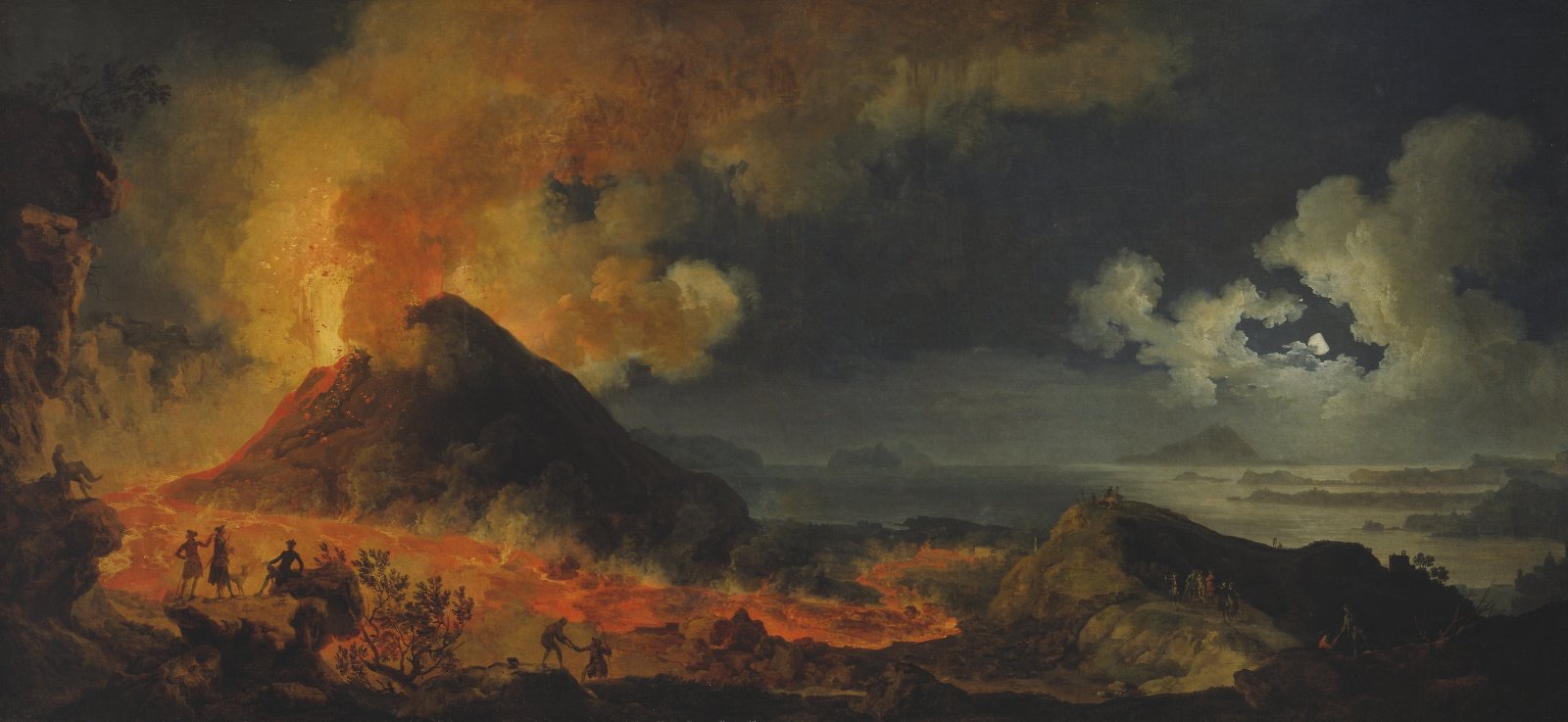
While the stone came down on Pompeii, the man commanding the fleet at Misenum was the boy's uncle: Pliny the Elder, author of the largest encyclopaedia Rome ever produced. His first order was for a light boat, to look closer. Then a message arrived from a woman named Rectina, trapped under the mountain, and the observation trip became a rescue: he launched the warships and steered them at the shore everyone else was fleeing.
…ashes were beginning to fall upon the ships, hotter and in thicker showers as they approached more nearly, with pumice-stones and black flints, charred and cracked by the heat. (PLINY THE YOUNGER, LETTER 6.16)
08 · Herculaneum
NIGHT · HERCULANEUM
The first current
takes Herculaneum.
Herculaneum stood upwind. Almost nothing had fallen on it all day; its people had time, and most of them used it to leave. Some three hundred who stayed went down to the stone boat-houses on the beach, to wait for morning or the sea. In the night, the edge of the column collapsed and came down the mountain as a current of gas and ash moving at ground level, faster than anything can run. It crossed the town in minutes. No one still in the town survived it; how fast they died is the argument below.
09 · The column falls
NIGHT INTO DAY TWO
The column stops
holding itself up.
A column like that stands on thrust, like water from a hose. When the vent widens and the gas weakens, it cannot hold, and what went up comes back down onto the mountain and pours outward along the ground: a pyroclastic current, hundreds of degrees, moving like an avalanche that does not care what is in the way. Through the night and into the morning the column fell and recovered again and again. Each fall reached further than the last.
- NIGHT · The first currents: Down the western flank. Herculaneum is crossed and buried; in the end it lies under about 20 metres of rock.
- DAWN · Closer: Successive currents run further down the southern and eastern flanks, toward the towns under the fall.
- ≈ 07:00 · The fourth: The fourth current reaches Pompeii, by the standard reconstruction of the deposits. (DAY TWO)
- AFTER · The largest: The last and largest currents reach Stabiae and lap at Misenum, thirty kilometres out, where the letters were later written.
10 · The morning
DAY TWO · ABOUT 07:00 · POMPEII
The morning current
ends it.
By then Pompeii had stood under falling stone for about eighteen hours. The people still alive had climbed as the town filled: in the Garden of the Fugitives, thirteen of them, adults and children, were caught crossing pumice already some three and a half metres deep. The current that came down that morning crossed the walls and the town in about a minute. Nobody it found lived. What it found, it sealed.
11 · Misenum
DAY TWO · MORNING · 30 KM AWAY
Thirty kilometres out,
the day does not come.
At Misenum, across the bay, the boy and his mother had stayed through a night of tremors; toward dawn, sitting out in the open while the buildings swayed, he called for a volume of Livy and read, as if at ease. Then the light that came was grey, and the cloud came down the bay after them over the water. They left the town in a crowd that pressed at their backs, and then the dark caught up.
…the blackness of night overtook us, not that of a moonless or cloudy night, but the blackness of pent-up places which never see the light. (PLINY THE YOUNGER, LETTER 6.20)
You could hear the wailing of women, the screams of little children, and the shouts of men; some were trying to find their parents, others their children, others their wives, by calling for them and recognising them by their voices alone. (THE SAME LETTER)
Some in the crowd said there were no gods any more, and that this night would be the world's last. Then the darkness thinned to smoke, the sun came back the colour of an eclipse, and everything they could see stood under ash like dirty snow. Misenum survived. They shook the ash off and went back, to a night passed between hope and fear: there was still no word of his uncle.
12 · The casts
1748 → 1863 · THE REDISCOVERY
The bodies were gone.
Their shapes stayed.
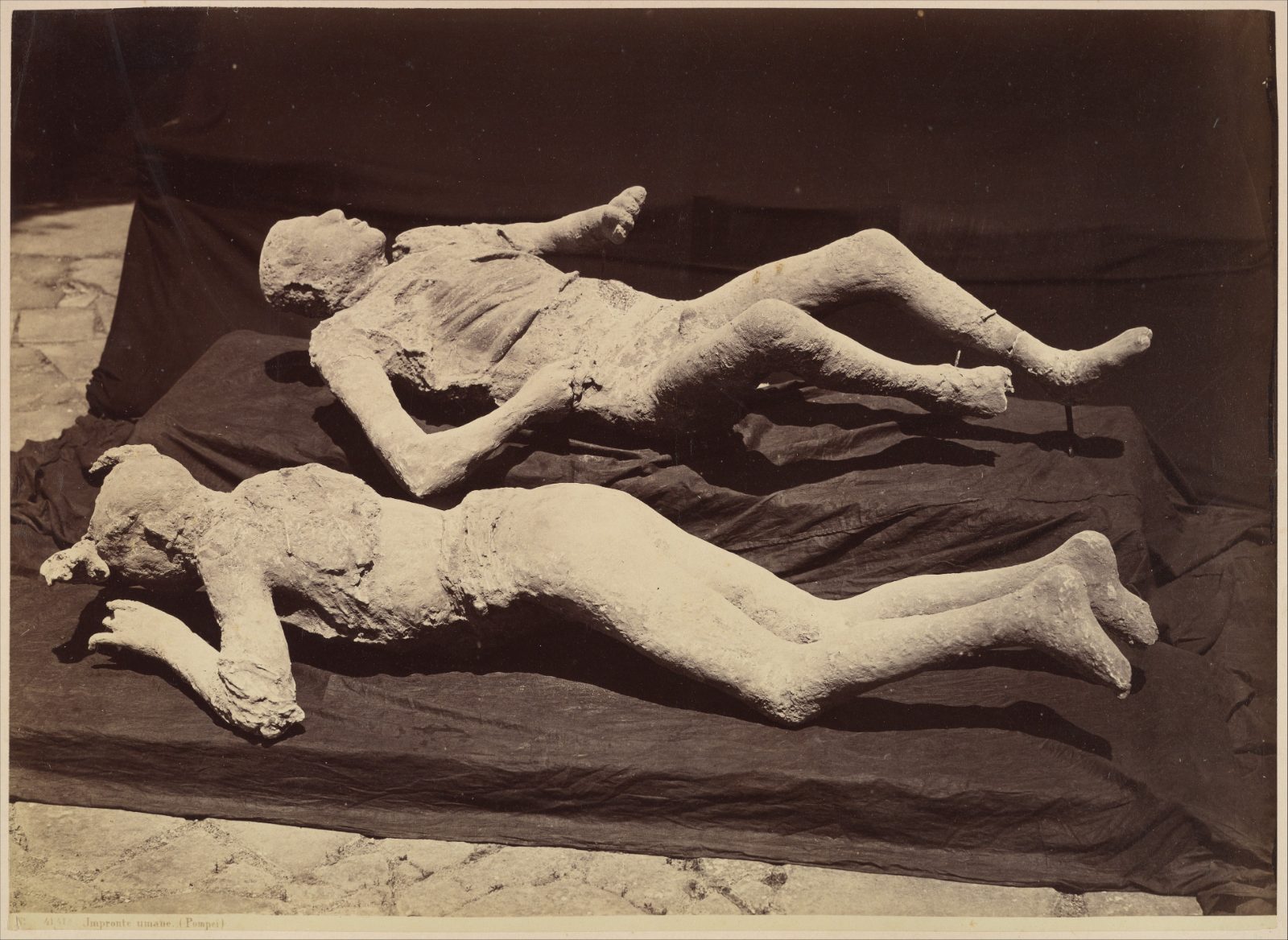
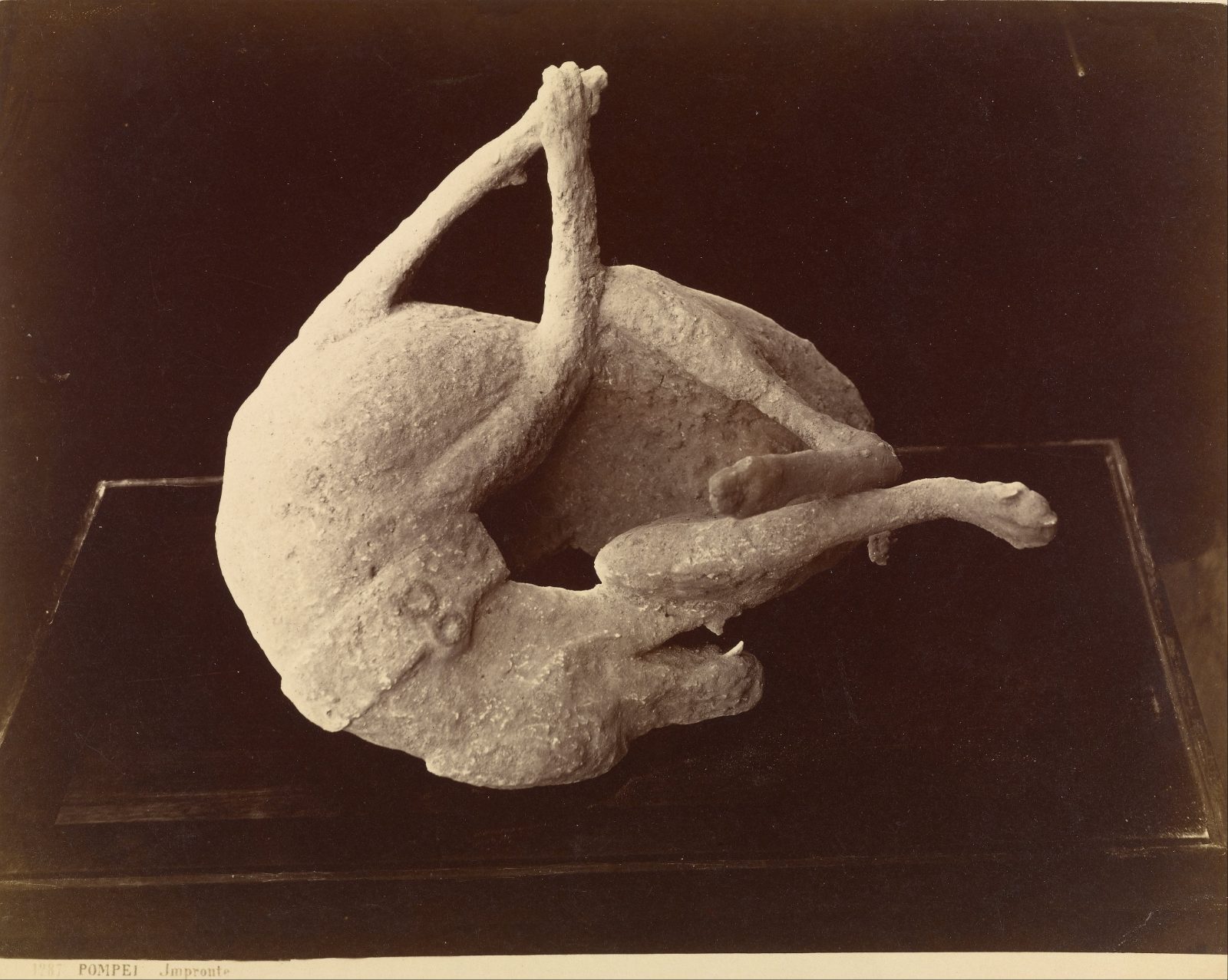
Pompeii was found again in 1748, under farmland that had kept its name as a rumour. For a century the diggers kept hitting hollows in the hardened ash with bones inside and could not say what they were. In 1863 the director of excavations, Giuseppe Fiorelli, understood: the ash had set around the dead before the bodies were gone. He poured plaster into the next hollow before opening it. What came out was not a statue. It was the space a person had left.
Ash hardens around a body. As the body decays it leaves a cavity. Plaster poured into that cavity preserves its shape. This diagram explains the process; it is not a reconstruction of a particular victim.
13 · The date
ONE MORE THING WE GOT WRONG
We are not even sure
of the day.
Every date in this story so far has been a season, not a day, and that is deliberate. The manuscripts of Pliny's letters say 24 August. The town itself keeps disagreeing: autumn fruit in the shops, braziers out, heavier fabrics, wine just sealed from the harvest, and a wind that October fits better than August.
XVI K NOV. 16 days before the Kalends of November · 17 October. Transcription of the date, not a facsimile. The inscription gives no year.
- 79 · The manuscripts: Copies of Pliny's letters give the 24th of August. No original survives; every later date begins by doubting the copies.
- 2018 · The charcoal: A wall in a house under excavation carried a note in charcoal, a material that does not last: the 16th day before the Kalends of November. The 17th of October, with no year. (XVI K NOV)
- 2022 · The synthesis: A major review by Italian institutes concludes the eruption was in autumn, most likely 24 to 25 October, after that inscription was written.
- 2024 · The park: Pompeii's own journal pushes back: the oldest manuscripts all give 24 August, the precise day in October rests on thin ground, and the question stays open.
14 · Still there
THE BAY OF NAPLES · NOW
The mountain is
still there.
Vesuvius last erupted in March 1944, into the middle of a world war: it buried villages in lava, killed 26 people, and wrecked some 80 Allied bombers parked at an airfield named Pompeii. Since then, nothing: the longest quiet spell the mountain has had in centuries. Volcanologists do not read that as mercy: the reservoir is still there, six to eight kilometres down, and a long rest is when a volcano like this can store fresh magma. What nobody can do is time it.
The oldest volcano observatory in the world has watched it since 1841. Today about 670 000 people live in the official red zone on its flanks, with a national plan that, once the order is given, is designed to move all of them out in 72 hours, and around three million live within reach of a bad day. Pompeii, a third of it still under the ash, is visited by millions every year. They walk the streets, look up, and see it: green, quiet, close.
From the pine tree to the last current was about eighteen hours. Emptying the mountain's slopes, when the order comes, is planned to take seventy-two.
Sources & notes
- Pliny the Younger, Letters 6.16 and 6.20, to Tacitus, translated by J. B. Firth (1900), at attalus.org: the pine-tree cloud, the seventh hour, the 24th of August in the manuscripts, the rescue fleet, ashes on the ships, the death at Stabiae, the darkness of pent-up places, the cries, the ash like snow archival copy
- Strabo, Geography 5.4.8, translated by H. L. Jones (Loeb, 1923), at LacusCurtius: Vesuvius before 79 as an ash-coloured summit of cinder-eaten rock, read as a district that in earlier times was on fire and had craters of fire, then quenched for lack of fuel archival copy
- Sigurdsson, Carey, Cornell and Pescatore, The eruption of Vesuvius in A.D. 79 (National Geographic Research 1, 1985), abstract: the Plinian phase from shortly after noon, about 7 hours of white pumice, the six surges, the first overwhelming Herculaneum, the fourth reaching Pompeii about 7 a.m., the largest reaching Stabiae and Misenum primary
- Sparice and colleagues, Frontiers in Earth Science (2024, with Pompeii park co-authors): pumice fall on Pompeii from around 1 p.m. at an average 15 cm an hour, maximum fall deposit 2.8 to 2.9 m, roofs collapsing under 40 to 60 cm, the currents from the early morning of the second day; the paper's central case is the eruption's own earthquakes, including two men crushed by a falling wall in the lull between the fall and the currents secondary
- Carey and Sigurdsson, Temporal variations in column height and magma discharge rate during the 79 A.D. eruption of Vesuvius (GSA Bulletin 99, 1987): the column's maximum of about 32 km primary
- Smithsonian Institution, Global Volcanism Program, Vesuvius: the eruption's magnitude (VEI 5, which the catalogue itself marks with a question mark) primary
- Luongo, Perrotta, Scarpati and colleagues, Impact of the AD 79 explosive eruption on Pompeii, part II (Journal of Volcanology and Geothermal Research 126, 2003): 1 044 recognisable bodies plus about 100 more from scattered bone, 394 of them in the pumice-fall layer primary
- Mastrolorenzo, Petrone, Pappalardo and Sheridan, Lethal thermal impact at periphery of pyroclastic surges (PLoS ONE, 2010): the Pompeii dead exposed to about 250 to 300 °C; heat, not asphyxia, at the S4 surge's edge primary
- Petrone and colleagues, Heat-induced brain vitrification from the Vesuvius eruption (New England Journal of Medicine 382, 2020): the vitrified brain of the young guardian at Herculaneum; charred wood at the site suggesting about 520 °C primary
- Giordano and colleagues, Unique formation of organic glass from a human brain (Scientific Reports 15, 2025): the glass formed above about 510 °C in a short-lived, dilute, very hot current, then cooled fast; the burying deposits at 315 to 465 °C primary
- Pensa, Giordano, Corrado and Petrone, Scientific Reports (2023): the first current into Herculaneum as a short-lived ash-cloud surge at about 495 to 555 °C; the town buried by later, cooler currents primary
- Martyn and colleagues, A re-evaluation of manner of death at Roman Herculaneum (Antiquity 94, 2020): collagen in the boat-house ribs implies exposure below about 400 °C; the argument that those victims baked rather than vaporised analysis
- Science (AAAS), on the Herculaneum studies (2020): more than 300 dead in the stone chambers by the beach, found from the 1980s on reporting
- Parco Archeologico di Pompei, Orto dei Fuggiaschi: the thirteen victims of the Garden of the Fugitives, caught on about 3.5 m of accumulated pumice by the morning current primary
- Pompeii Cast Project, Papers of the British School at Rome (2015): Fiorelli's plaster method from 1863 and the corpus of about 104 casts secondary
- Pilli and colleagues, Current Biology (2024): ancient DNA from the casts; the adult with the golden bracelet holding a child was an unrelated male primary
- Parco Archeologico di Pompei, press release (19 October 2018): the charcoal inscription of Regio V reading the 16th day before the Kalends of November, 17 October primary
- CNR press release on Doronzo and colleagues, Earth-Science Reviews 231 (2022): the autumn synthesis; the most accredited date now 24 to 25 October primary
- Parco Archeologico di Pompei, e-journal (December 2024), La data della distruzione di Pompei: the park's own case that the manuscripts still support 24 August and the question remains open primary
- Encyclopaedia Britannica, Pompeii: a town of 10 000 to 20 000 people, the earthquake of 62, burial under 4 to 6 m of ash and pumice, excavations from 1748 secondary
- Encyclopaedia Britannica, Herculaneum: the town's burial under some 20 m of volcanic material, excavations from 1738 secondary
- National Geographic, on the unexcavated third of Pompeii: about 22 of 66 hectares deliberately left buried reporting
- INGV, Osservatorio Vesuviano: the world's oldest volcano observatory, founded 1841, now the Naples section of INGV primary
- Dipartimento della Protezione Civile, the national plan for Vesuvius: the red zone of 25 municipalities and about 670 000 people, the 72-hour evacuation framework primary
- EARTH Magazine, Benchmarks: March 17, 1944, the most recent eruption of Vesuvius: the lava through San Sebastiano, 26 dead, the Allied occupation secondary
- The Aviation Geek Club, veterans' accounts of the 1944 eruption at Pompeii Airfield: the ash-wrecked B-25s of the 340th Bombardment Group (counts vary, about 80) reporting
- ScienceDaily, on INGV-related research (2022): the current repose as the longest in centuries, the closed-conduit state of the volcano, the reservoir at about 6 to 8 km depth and the accumulation of magma during long quiescence secondary
- Volcano World, Oregon State University, Vesuvius: about 4 cubic kilometres erupted in about 19 hours; the column at times about 32 km secondary
- Giorgio Sommer, Plaster casts of bodies, Pompeii (about 1875), The Metropolitan Museum of Art, CC0: the casts photograph archival copy
- Giorgio Sommer, Cast of a dog killed by the eruption of Mount Vesuvius, Pompeii, The J. Paul Getty Museum via Google Art Project, public domain: the dog photograph archival copy
- Pierre-Jacques Volaire, The Eruption of Vesuvius (1771), Art Institute of Chicago, CC0: the painting archival copy
- United News newsreel No. 99 (US Office of War Information, 1944): the eruption of Vesuvius and the lava at San Sebastiano; National Archives 208-UN-99, listed unrestricted: the film clip archival copy
- Parco Archeologico di Pompei, A Guide to the Pompeii Excavations: city plan, Forum and individual monuments used as architectural references primary
- INGV / Osservatorio Vesuviano, eruption history: the changing Somma-Vesuvius edifice primary

_-_Google_Art_Project.jpg)
Times of day are modelled reconstructions, not records: the whole clock of this story hangs on two moments in Pliny the Younger's letters (the cloud sighted about the seventh hour of day one; the tremors and flight at daybreak of day two), and the hours between follow the reconstruction of Sigurdsson and Carey (1985) as carried into current work (Sparice and colleagues, 2024, with Pompeii park co-authors), which is why every hour is written with about. The onset is given as shortly after noon to about 1 p.m.; the current that reached Pompeii is placed about 7 a.m. by Sigurdsson (1985) and from 8 a.m. by Sparice (2024); this story says about 07:00 and treats the difference as the uncertainty it is. The eighteen hours of the title span the fall's onset to the morning currents; the literature also gives about 19 hours for the whole eruption. The six currents follow Sigurdsson and Carey's numbering (S1 to S6); Italian stratigraphy divides the same deposits differently (EU units). The column's 32 km is Carey and Sigurdsson (1987); the paper is paywalled and the figure is taken from its abstract and citing literature. Strabo's reading of the summit as old, quenched fire is Geography 5.4.8; ancient recognition that the mountain had once burned is a different thing from foreknowledge of the eruption, and the story keeps the two apart. Letter 6.20 places the boy's reading of Livy before the flight from Misenum, during the tremors, and the night after the family's return as an anxious wait for news of his uncle; the story follows that order. Pliny's pinus is the Mediterranean umbrella pine; the public-domain Firth translation (1900) says pine-tree, and the quotations here are Firth's wording exactly, from attalus.org, whose page notes a few modified words; the Latin is unaffected. Pliny the Younger's age (seventeen) is his own statement in letter 6.20 that he was in his eighteenth year. Misenum's distance is rounded to 30 km following the volcanological literature. Roof collapse at 40 to 60 cm and the average fall rate of 15 cm an hour are Sparice (2024) after Sigurdsson (1985) and Luongo (2003); the fall was episodic, so the bury instrument's hours between published depths are a smooth reconstruction and say so. The body counts are Luongo and colleagues (2003): 1 044 recognisable bodies plus about 100 individuals from scattered bone, 394 in the fall layer; the true toll is unknown, since only about two-thirds of the town is excavated and many died outside the walls. Temperatures are a live dispute presented as one: about 250 to 300 °C at Pompeii (Mastrolorenzo and Petrone, 2010), about 500 °C and above at Herculaneum (Petrone 2020, Pensa 2023, Giordano 2025), under about 400 °C in the boat chambers (Martyn and colleagues, 2020, who also question heat as the sole killer); later work cited there argues asphyxiation for some Pompeii deaths. The vitrified brain was reported in 2020 (Petrone and colleagues, NEJM); its formation conditions, above about 510 °C with very fast cooling, are Giordano and colleagues (2025), and the story dates the two findings separately. The eruption's own earthquakes and the two men crushed by a falling wall are Sparice and colleagues (2024); seismic shaking does not explain every collapse and the story does not say it does. Herculaneum's dead by the shore number more than 300 (Science, on excavations from the 1980s on); about 340 is also published. The date: the manuscripts of Pliny give 24 August; the charcoal inscription of 2018 reads XVI K Nov, 17 October, with no year and an unknown writer; the CNR-INGV synthesis (2022) concludes autumn, most likely 24 to 25 October; the park's own journal (2024) holds the day open, and so does this story, whose chapters therefore say day one and day two. The 1944 aircraft count varies between about 78 and 88 in published accounts and is written as some 80. The red zone figure is the civil protection plan's about 670 000; about 700 000 also circulates. The plan's 72 hours are the planned duration of the red zone's evacuation once it is ordered, not a promised interval of warning before an eruption. The Volaire painting shows the eruption of 1771, not of 79, and is captioned as such. Photographs and the painting are public domain or CC0, unaltered except for size. The 1944 film clip is sixteen seconds of United News newsreel No. 99, a US government production held by the National Archives as unrestricted, cropped and muted, otherwise unaltered. Visual reconstruction: city blocks and architectural types are simplified from archaeological references, not surveyed building-by-building. Intact roofs and upper storeys are inferred. The summit is an interpretive filled profile over a modern DEM, not a recovered pre-79 surface; the regional coast is a modern geographic reference. Currents and the fleet route are schematic reconstructions, not fluid simulations or recorded tracks. Regional and architectural dimensions use 4.4 kilometres per scene unit. The cast diagram and inscription transcription are explanatory drawings, not archival images.